

AMI
AMI is an abbreviation for advanced metering infrastructure.
The meters help Sun Prairie Utilities operate cost-effectively and provide more proactive and reliable service to our customers. Advanced meters are essential in modernizing our community’s electric and water systems. The information collected by an advanced meter will be used for the same purpose as the data from the old meters: measuring consumption and preparing a bill.
No. Sun Prairie Utilities’ use of AMI is not anticipated to impact electric or water rates. The new technology will help bring savings to the Sun Prairie community. Staff will no longer need to drive around the city to read the meters. This eliminates fossil fuel emissions from meter-reading vehicles and allows Sun Prairie Utilities staff to better utilize their time by providing other high-value services for our community.
Sun Prairie Utilities’ use of advanced meters will help us operate more cost-effectively. The utility’s old system required sending workers in trucks to complete monthly readings, conduct regular testing, and perform disconnections and reconnections.
The new meters eliminate the fossil fuel emissions from meter-reading vehicles and allow SPU staff to better utilize their time by providing other high-value services for our community.
Advanced meters can also quickly alert us to problems that drive up costs for our utilities and our customers. We will be able to more quickly alert customers to costly water leaks, and advanced meters also allow faster detection of instances of theft and meter tampering.
Advanced meter data will enable our customers to analyze their electric and water consumption and take advantage of efficiency programs that will provide customers with more control over their usage and bills.
AMI meters utilize a radio frequency to supply near real-time data on electric or water use to Sun Prairie Utilities’ system, which alerts us when electric service is interrupted and allows for responding staff to be notified automatically.
It is a safe, secure, and effective two-way radio frequency (RF) communications link.
AMI meters primarily use radio frequency mesh networks for two-way communication, allowing them to send and receive data with a utility company through wireless signals. This allows for real-time monitoring of energy and water usage. It also enables features like remote disconnections, outage detection, and detailed usage analysis.
Wisconsin utilities are required to protect customer usage and billing information, and Sun Prairie Utilities works constantly to safeguard this data.
Yes. While advanced meters have become the subject of considerable attention for their use of low-level RF, an in-depth review of the scientific literature by the World Health Organization (WHO) confirmed that the small amount of RF energy produced by smart meters is not harmful to human health.¹
In the US, the Federal Communications Commission establishes the requirements for using the RF spectrum and acceptable exposure limits for the public. Sun Prairie Utilities’ advanced meters comply with and are far below these requirements and international requirements set by global bodies. Sun Prairie Utilities takes our customers’ health and safety seriously, and we will never install equipment that jeopardizes their safety and well-being.
The low level of RF emissions associated with advanced meters is far smaller than other common household items.² In fact, everyday devices such as cellular phones and microwave ovens typically cause far greater RF exposure than advanced meters.³ In terms of RF output, Sun Prairie Utilities’ advanced meters typically compare as follows to other common household wireless devices:⁴
- Smart Meter (900 MHz)
- Baby Monitor (7 times greater)
- Wii Remote Controller (30 times greater)
- Nintendo DS with WiFi (180 times greater)
- Wifi Access Point (400 times greater)
- Cordless Phone (1,000 times greater)
- Cell Phone (10,000 times greater)
Furthermore, RF exposure decreases with distance from the device. Sun Prairie Utilities’ advanced meters are typically installed on the exterior of a building for electricity or in the basement for water. In contrast, much higher-emitting devices such as microwaves and mobile phones are often operated a few inches or a few feet from the user. In addition, while other standard household devices emit RF signals far more frequently or even constantly, Sun Prairie Utilities’ advanced meters typically will only transmit a signal four times per day, and each transmission lasts for approximately one second.
(2) Environmental Defense Fund.
(3) Richard A. Tell, Richard Tell Associates, Inc. (April 6, 2005).
(4) Based on FCC 47CFR1 . 1310, which averages exposure over 30 minutes of usage. Comparative data provided by Elster.
Billing
This is a variable component of our rates as approved by the Wisconsin Public Service Commission (PSC). The Power Cost Adjustment Clause (PCAC) is a monthly pricing adjustment comparing actual purchased power costs to allocated costs as approved by the PSC.
If actual costs are greater than the allocated, the result is an additional per-kilowatt hourly charge on your bill. If actual costs are less than allocated, the result is a per-kilowatt hourly credit on your bill. The PCAC assures you are only paying the actual costs associated with your actual consumption. View more information here.
During times of peak demand for electricity, such as the summer and winter months, the cost to purchase power is typically higher.
The PCAC also varies monthly depending on the wholesale cost Sun Prairie Utilities pays to purchase electricity to meet all of its customers’ needs.
Sun Prairie Utilities does not offer alternative billing or due date schedules. Statements are issued and mailed by the 10th of each month, and payment is due on the 30th, or the next business day if the 30th falls on a weekend or holiday.
Sun Prairie Utilities would direct any local resident who is in need of assistance to contact the help organizations at the Sun Prairie Sunshine Place. Income-qualified residents could also contact Energy Services Inc. at (800) 506-5596. Energy Services provides assistance for home heating each heating season. Anyone in need of assistance could also call 2-1-1.
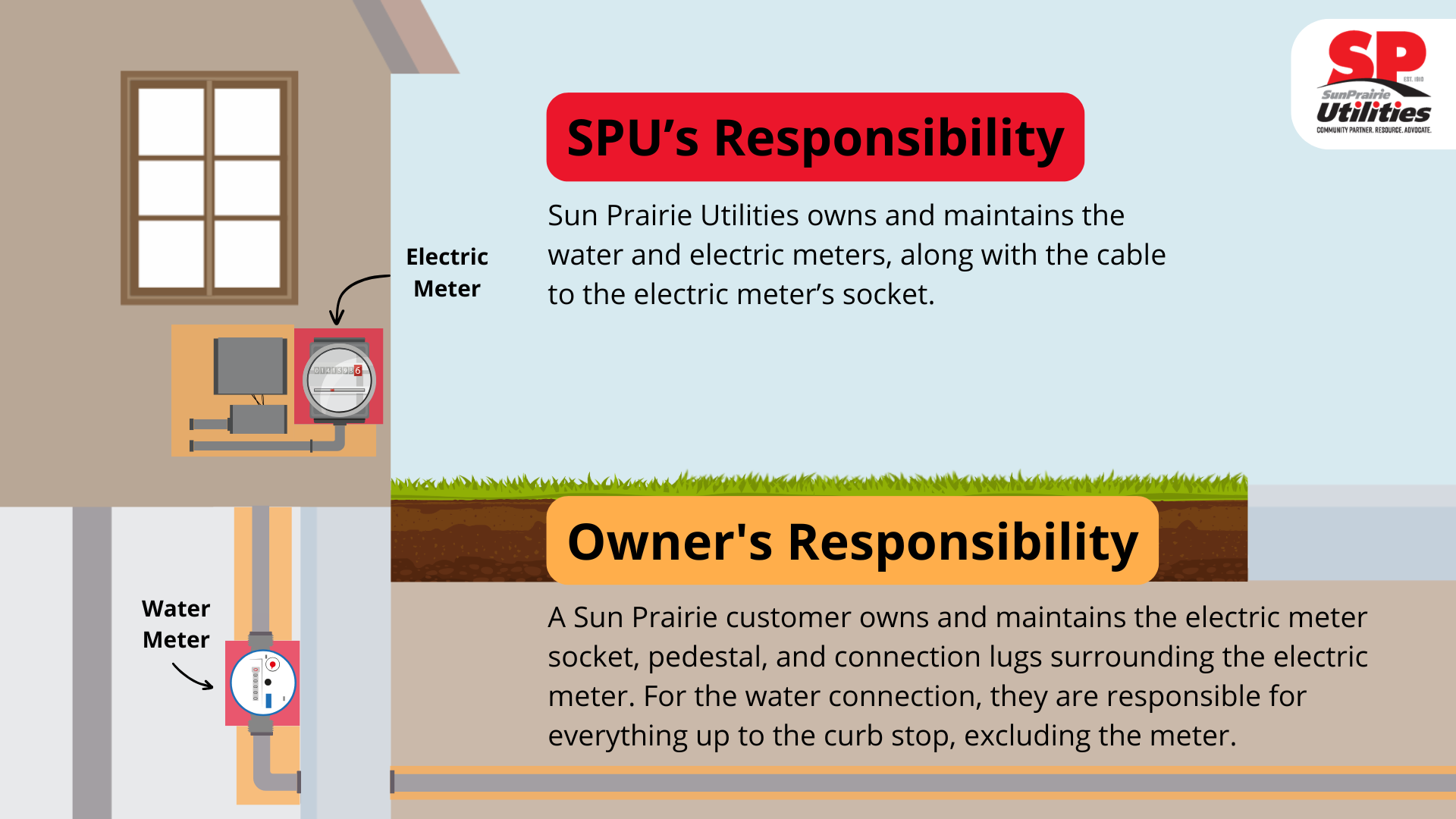
Sun Prairie Utilities owns and maintains the water and electric meters, along with the cable to the electric meter’s socket.
A Sun Prairie customer owns and maintains the electric meter socket, pedestal, and connection lugs surrounding the electric meter. For the water connection, they are responsible for everything up to the curb stop, excluding the meter.
Additionally, meter information can be found in the City Code of Ordinances under Chapter 13.08 Water Service System, specifically 13.08.190 and 13.08.200 (click here to view the chapter).
Choose Renewable
Customers can sign up for the Choose Renewable program, which allows the purchase of 300 kilowatt-hour renewable energy blocks for $2 each.
This additional cost can be added to your monthly utility bill, and three blocks are enough to offset an average home’s energy usage.
There is no equipment to buy or install, which means no worry over payback periods or annual maintenance costs.
As a member of WPPI Energy we have access to a portfolio of renewable energy resources.
Choose Renewable’s energy resources come from multiple facilities in the upper Midwest. See the current renewable energy mix here.
Electricity generated by the renewable resources will be fed into the electric power grid along with all other power sources serving our community. While it isn’t technologically possible to deliver electricity from renewable resources directly to your home or business, your support for the Choose Renewable program will enable us to increase the overall amount of clean, renewable resources that are a part of our power supply.
Yes. Commercial, industrial, and agricultural customers are encouraged to sign up for Choose Renewable.
The money you invest each month in Choose Renewable is used to help lower renewable energy resource costs and increase the amount of electricity generated from clean energy sources.
The majority of your Choose Renewable investment is allocated to the development of renewable resources, such as additional solar and wind energy projects. The rest is used to build support for renewable energy among other customers like you, as well as businesses and organizations in your community.
Broad support for renewable technologies across our communities will add up to greater demand, which, in turn will increase the investment made in renewable energy.
Electric
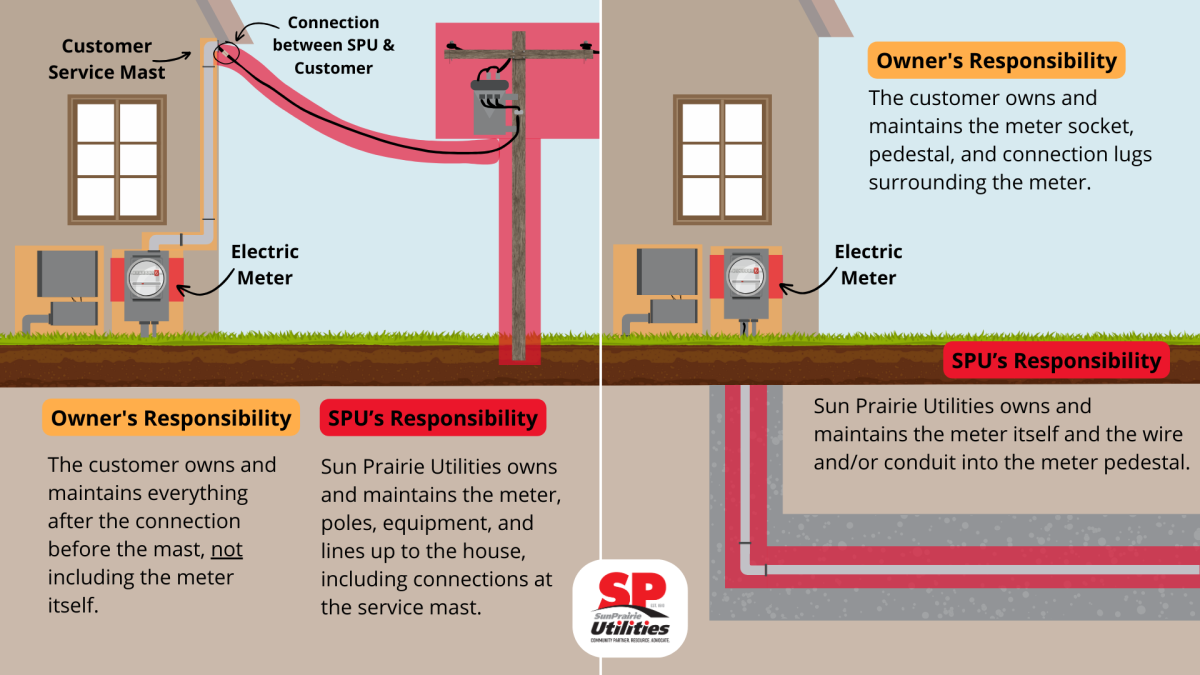
When the system is above-ground, the customer owns and maintains everything after the connection before the mast, not including the meter itself. Sun Prairie Utilities owns and maintains the meter, poles, equipment, and lines up to the house, including connections at the service mast.
For below-ground systems, the customer owns and maintains the meter socket, pedestal, and connection lugs surrounding the meter. Sun Prairie Utilities owns and maintains the meter itself and the wire and/or conduit into the meter pedestal.
Sun Prairie Utilities is one of over 2000 Public Power utilities across the nation. A Public Power utility is generally not-for-profit and is owned by the community to which it serves and strives to provide reliable and low cost electric service. Our Sun Prairie forefathers had the foresight to form the Sun Prairie electric and water utilities over 100 years ago. They knew local control and cost savings were important Sun Prairie benefits, and these same benefits are received today through Sun Prairie Utilities.
Hydrant Flushing
Hydrant flushing is the release of water from fire hydrants. It is a controlled procedure that is vital to the general maintenance of Sun Prairie’s water distribution system.
Utilities usually flush to improve water clarity, appearance, and quality by clearing settled iron and other minerals from the water mains (distribution pipes.)
Hydrant flushing helps avoid random occurrences of rusty water if there is a large demand for water, such as during a major firefighting effort. Water mains are also flushed to physically operate the hydrant (called “exercising”) and to inspect for hydrant maintenance needs.
Water main flushing stirs up mineral sediment that can temporarily cause yellow, brown, or reddish water.
If you have discolored water:
- Go to a faucet on the lowest level of your home or business, like a basement utility sink or first-floor bathtub.
- Remove the screen or aerator from the faucet (if applicable) and temporarily bypass whole-home water softeners or filters if you have them.
- Run the cold water only at full force for a few minutes until the water clears. Once it does, replace the faucet screen/aerator and put any bypass filters or softeners back in service (if applicable).
- If your water doesn’t clear after a few minutes, call us at (608) 837-5500.
- If you have lower pressure than usual at a faucet, remove the screen or aerator to check if it’s clogged. If it is clogged and doesn’t rinse easily, soak it in vinegar for at least 15 minutes and scrub it with an old toothbrush.
- If you have a water softener and are experiencing discolored water, place the unit into “regeneration or cleaning mode” after hydrant flushing is completed in your area.
We also suggest waiting until the evening to do laundry or run your dishwasher if we’re flushing in your neighborhood – and make sure your water is clear before starting these tasks. Discolored water can stain clothes and porcelain.
You may see a drop in water pressure while crews flush a hydrant near you. If the pressure seems low after it is done, we recommend checking your faucet for trapped particles.
Your water may become discolored, and it may linger for a few hours. It is not harmful to drink. If this happens, we recommend you run your cold water tap for a few minutes until the water is clear. If it does not turn clear after the first try, wait a few minutes and repeat. Avoid washing clothes until the water clears.
Yes, discolored water is safe to drink.
While low concentrations of minerals are harmless, they can discolor the water and cause concern about the water quality. Sun Prairie’s low iron means there is not much iron to flush out, but caution should still be exercised when running loads of laundry.
Keep the laundry wet and use an iron or stain-removing product like “Iron Out” rust and stain remover.
Sun Prairie Utilities flushes hydrants at least every other year as required by Wisconsin State code NR 810.13. In areas where water may move more slowly through the system, such as hydrants located on a dead-end main, hydrants are flushed twice annually to maintain water quality.
Sun Prairie has approximately 1,800 public fire hydrants to flush and it takes quite a while to operate and inspect each hydrant. Typically, flushing takes place April through October each year. Flushing is worked into our crew’s schedule based on weather, staffing levels, and other scheduled work so it is difficult to provide a schedule with specific dates or times.
For more information, contact Sun Prairie Utilities at information@myspu.org or (608) 837-5500.
Water
In the City of Sun Prairie, the City determines ownership of the sanitary lines, and it’s outlined in the City Code of Ordinances under Chapter 13.12 Sewer Service System, specifically 13.12.010 and 13.12.020 (if viewing digitally, click this hyperlink to go to the chapter).
Additionally, the City Code of Ordinances also defines what Sun Prairie Utilities (SPU) owns and maintains. This can be viewed under Chapter 13.08 Water Service System, specifically 13.08.040, 13.08.180, and 13.08.210 (click here to view the chapter).
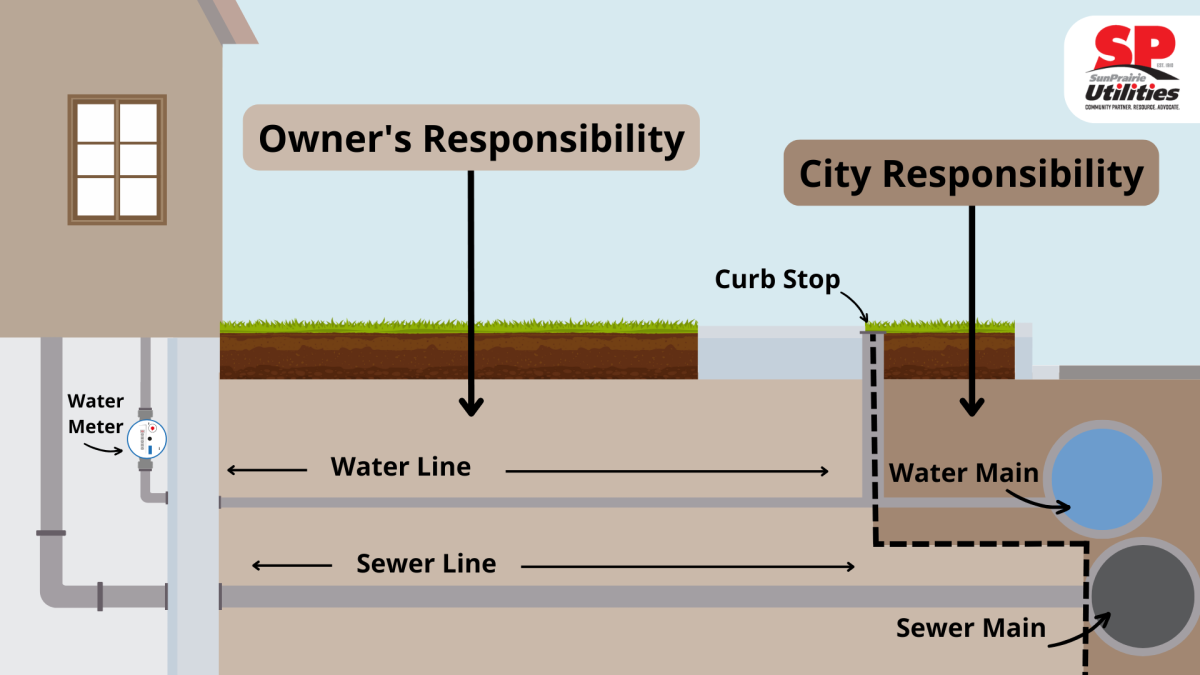
The potable water pipe / line is the owner’s responsibility up to their curb stop. The remaining water pipe and the water main are Sun Prairie Utilities’ responsibility.
The sewer pipe / line is the owner’s responsibility up to the main, which is usually found under a road. The sewer main is the City of Sun Prairie’s responsibility.
Sun Prairie drinking water comes from a deep sandstone aquifer, an underground rock formation where water collects in small spaces among the rocks. Groundwater originates as rain or snow, soaks into the ground, and is naturally filtered through layers of soil and rock before replenishing the aquifer.
This type of water storage ensures that water pressure and water volume are stabilized. Sun Prairie Utilities also has ground level reservoirs that ensure a sufficient water supply to fight fires, even if the electricity that normally pumps water is turned off.
If the utility has to meet rising customer demand every year to accommodate population growth, it must continually increase its pumping and delivery capacity, and it could eventually need to find additional sources of water. Each increase in capacity and supply means increased costs to develop and operate; these, in turn, eventually lead to an increase in customer rates. Therefore, it is less expensive for everyone to invest in water conservation than in increased supply.
Additional benefits of water conservation include improved water quality, a reduced burden on surface water quality since less wastewater is generated, and reduced greenhouse gas emissions due to reduced energy spent on water pumping. Plus, the customer sees a smaller water bill.
Sun Prairie’s tap water is considered to be ‘very hard’, because of the minerals such as calcium and magnesium in the rock formations from which we draw water. This water contains approximately 22 grains of hardness per gallon.
The high quality deep aquifer supplying our drinking water requires little treatment. However, chlorine is used to kill bacteria and viruses that could be found in the water. It’s considered one of the most important tools for disinfecting drinking water. It’s actually been in use for more than 100 years and is responsible for ending disease epidemics that were widespread prior to its use.
Fluoride has been added to treated water to reduce the risk of dental cavities. The Public Health Madison Dane County advises about setting the fluoride target level for treated water to maximize dental health benefits and minimize concerns about over exposure. You can read their policy statement on fluoridation of public drinking water here. The Center for Disease Control and Prevention (CDC) has recognized water fluoridation as one of ten great public health achievements of the 20st century.
A silent leak is usually a toilet where the flapper inside of the tank does not seal properly. This poor seal allows the water in the tank to seep from the tank into the bowl continuously and can add up to a significant amount of water.
To check for a leaky toilet, add a drop or two of food coloring into the tank of the toilet. Do not flush the toilet for 20-30 minutes. If the coloring shows in the toilet bowl after 20-30 minutes, that is an indication of a leak.
The answer is clear: tap water! That’s because our water is of excellent quality, strictly monitored, and affordable.
When we look at issues such as quality, monitoring and affordability, we see that bottled water doesn’t always make the grade. For instance, some brands may be of excellent quality, but others can have inferior quality or they may be simply taken from municipal water supplies. And all bottled waters are expensive. For the price of one small bottle of water, you would be able to buy about 750 gallons of Sun Prairie tap water. There is also less environmental impact with tap water, having no plastic waste to dispose of.
Another important fact: there are fewer government regulations to guide the bottled water industry. Monitoring requirements aren’t as stringent as are those for tap water. For quality, consistency and affordability, tap water wins every time.
Water meters are typically located in a basement, usually by the water heater or laundry. In some instances, water meters are located in a mechanical room or closet. There are city ordinances requiring clear access to our meters. Please keep this in mind when planning any type of remodeling or finishing of basement areas.
Matter or particulates suspended in a glass of water can be the result of a couple of items. If you are experiencing this in only one faucet in your home, it is likely a dirty faucet aerator. Try removing the aerator and see if this clears the matter. If so, replace the aerator with a new one. If not, call our office at (608) 837-5500.
If you are experiencing matter throughout all of your house faucets, it is likely due to water main work, such as repair or replacement, or hydrant flushing. To clear this matter, turn on all faucets full open and run them for 5-10 minutes to clear the lines of matter that was stirred up from the water main work. If this does not clear the matter from your water, call our office at (608) 837-5500.
Lead most commonly enters drinking water through the corrosion of service line pipes (also known as laterals or water lines) and plumbing materials. Sun Prairie Utilities (SPU) maintains an inventory database where customers can request information about the existing water lateral size and materials of their home or business.
Note: The information provided in SPU’s water lateral inventory is based on the most current information available and does not detail the internal plumbing of any property.
In 2023, SPU reported that over 130 private lead and galvanized water services were replaced by utilizing more than $700,000 from the State of Wisconsin’s Safe Drinking Water Loan Program. If you think you might have a lead service line, please follow the steps in this document – How to identify if you have a lead service pipe (English) (Spanish) (Hmong).
To request and/or report water lateral information, email lateralinfo@myspu.org with your name, address, and SPU account number.
For lead and copper regulation information, please click this link to visit the Department of Natural Resources website.